
"The Great Mouse Detective" Directors Share 40th Anniversary Stories at LightBox Expo


Forty years after The Great Mouse Detective paired the directing duo behind The Little Mermaid, Aladdin, Moana, and more, Ron Clements and John Musker reunited to celebrate. Tonight at LightBox Expo in Pasadena, the pair sat down for “The Great Mouse Detective 40th Anniversary,” a conversation moderated by Nick Manfredi, a former Disney animator and host of the Nick’s Friends on Film podcast. Many of the stories come straight from Clements’ new memoir, Making Disney Magic . . . from a Mermaid to Moana: Tales of a Disney Animation Director.
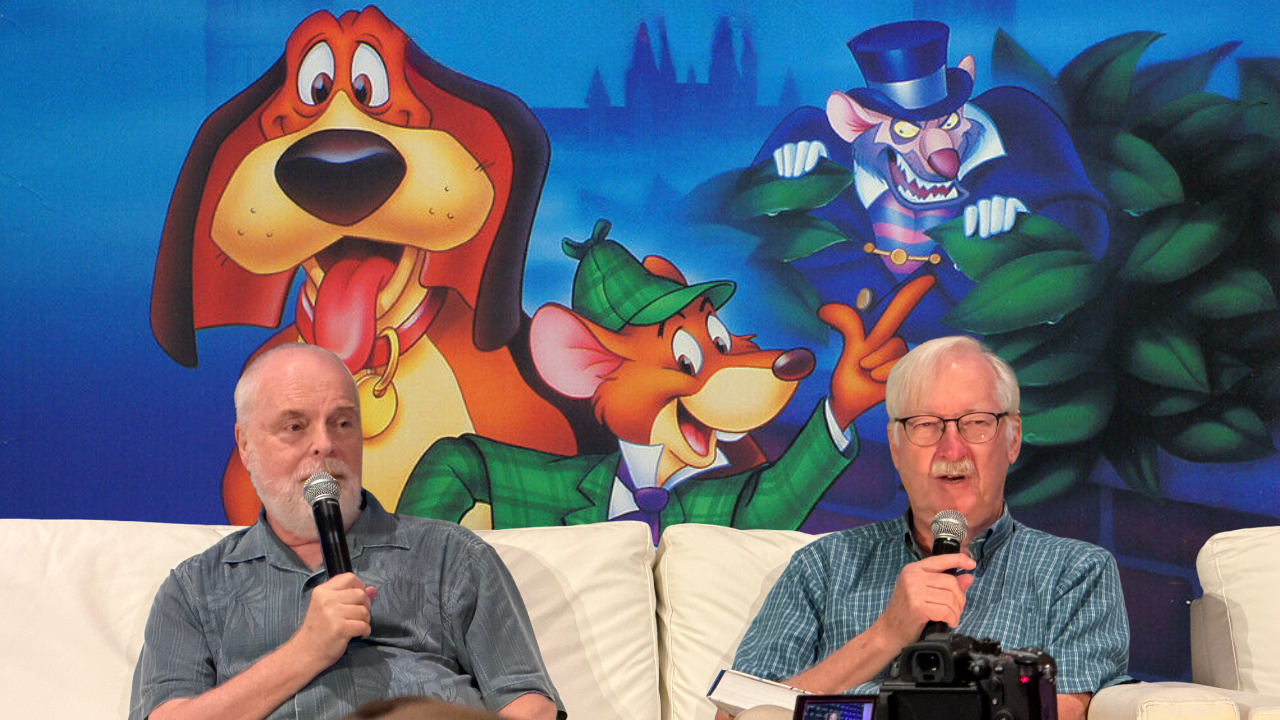
For Clements, the road to Basil of Baker Street started long before Disney. As a teenager in Sioux City, Iowa, he was a devoted Sherlock Holmes fan, worked part-time as a graphic artist at the local TV station, and animated commercials for local businesses. He used the station’s equipment on his own time to make a 15-minute animated short called Shades of Sherlock Holmes, voicing Holmes, Watson, and Moriarty himself. That film later got him a job at Hanna-Barbera. And while he only had a single-cel setup to show, Clements recreated the voices for the LightBox Expo audience.
Years later, while Clements was struggling in story on The Black Cauldron, producer Joe Hale mentioned that studio head Ron Miller was looking for new feature ideas. Clements suggested Eve Titus’ Basil of Baker Street books, and Hale had layout artist Don Griffith draw an illustration to help pitch it. Miller put the project into development, and Mel Shaw wrote a treatment and drew a series of pastels. But the road to the screen was far from over.
Musker, a sequence director on The Black Cauldron at the time, moved over to “Basil” as co-director alongside Burny Mattinson. He wasn’t interested in making a cute little mouse movie, so he pushed it toward an all-out comedy. In that version, Basil was a moody egomaniac, John Cleese was his dream voice for the detective, and the influences ran from Monty Python to Citizen Kane. Ron Miller hated it. Veteran story artist Vance Gerry was the next writer brought on board to give the story the warmth Miller felt it lacked.
Clements offered insight into the studio's mood in the mid-1980s, when the film was in heavy development. Corporate raider Saul Steinberg was buying up Disney stock with plans to break the company apart, and Ron Miller resigned in September 1984. Roy E. Disney came back with the Bass brothers as white knights to fend off the takeover, and they hired Michael Eisner and Frank Wells to run the studio. Eisner brought Jeffrey Katzenberg with him from Paramount.
By then, “Basil” had been in development for about two years. It had storyboards, story reels, a voice cast, and Henry Mancini lined up to compose the score, but the team was told to pitch it to Eisner and Katzenberg as if it were a brand-new idea. Clements explained that it helped that the new bosses had just been involved in Paramount’s Young Sherlock Holmes, a project they were high on. Eisner liked the pitch but asked for the film at half the proposed budget and in one year instead of two. That night, Roy E. Disney called Burny Mattinson with the green light and told him the studio had planned to shut down the entire animation department if “Basil” hadn’t been approved.
That deadline changed Clements’ career. Mattinson moved up to producer and felt he couldn’t direct at the same time, opening a spot for another sequence director. Encouraged by Musker and story artist Bruce Morris, Clements pitched himself to Mattinson and got the job alongside Musker.
Mattinson was credited with two of the film’s biggest assets: Mancini’s score and Vincent Price. Mattinson had the team watch the 1950 comedy Champagne for Caesar, where Price plays a manic, theatrical villain, and Glen Keane animated test poses to some of Price’s dialogue from that film to sell the idea.
Clements remembered his first time ever directing an actor, which happened to be Price recording Ratigan’s song and soliloquy. Nervous, he suggested Price try a line again “through tears,” and Price praised the note with a warmth Clements is convinced was meant to settle his nerves. It worked. Musker’s experience was less cozy. He joked about the time he managed to make Price mad by making him do too many variations of the same line.
Ratigan’s look has its own origin story. “When in doubt, base the villain on your boss,” Musker quipped. He explained that it was Glen Keane’s idea. The original Ratigan design was thin and gaunt, but Keane kept thinking about Ron Miller’s imposing physique, a tall, broad-shouldered man. Keane turned Ratigan into a big, barrel-chested rat. Clements clarified that the resemblance stopped at the body, since Miller himself was charming and down-to-earth.
When Manfredi asked about the dynamic between Basil and Ratigan, Clements said he drew more from Arthur Conan Doyle than from the Titus books, with Holmes and Moriarty as the template: two brilliant minds constantly trying to outthink each other. Clements also came up with Ratigan’s insistence that he isn’t a rat at all, just a very big mouse.
Musker told the legendary story of the title change. Young Sherlock Holmes opened that Christmas to disappointing results, and Katzenberg decided audiences didn’t want anything to do with Sherlock Holmes. The marketing dropped every hint of Holmes, and “Basil of Baker Street” became The Great Mouse Detective, a title the directors hated. Soon after, a fake memo from story artist Ed Gombert, made to look like it came from executive Peter Schneider, appeared around the studio announcing that every Disney classic would get a similar title. Snow White and the Seven Dwarfs would become “Seven Little Men Help a Girl,” and Pinocchio would be “The Wooden Boy Who Became Real.”
Schneider was furious and wanted the author fired, but nobody talked. Musker explained that writer Steve Hulett later sent the memo to the Los Angeles Times, which ran a story about it, and Jeopardy made the fake titles a category. Clements joked that the memo got more publicity than the movie.
Clements gave a brief plug for his book, which started as a history of the post-Walt era of Disney Animation that he and Musker planned to write together before Musker retired in 2018. Musker added that he’d like to publish a book of his caricatures someday. He has drawn hundreds of them over the years, many poking fun at Clements, and several appear in Making Disney Magic.
To close, Manfredi asked what The Great Mouse Detective means to its directors with four decades of hindsight. Clements pointed out that Sherlock Holmes is more popular today than ever, which is a nice twist for a film whose marketing was built to hide that it was a Holmes story. Musker sees the film as part of a long Disney tradition of adapting classic authors, from Arthur Conan Doyle to Hans Christian Andersen, whose The Little Mermaid became the pair’s next film. He called those adaptations a learning opportunity, a way for young audiences to discover the original stories and the writers behind them.
Making Disney Magic . . . from a Mermaid to Moana by Ron Clements is now available wherever books are sold.
(Please note this article contains affiliate links. Your purchase will support LaughingPlace by providing us a small commission, but will not affect your pricing or user experience. Thank you.)