
Cory Loftis Breaks Down the Visual Development of "Zootopia 2" at Annecy Festival


As Walt Disney Animation Studios gets ready to present new footage from its next animated feature, Hexed, at Annecy Festival, Production Designer Cory Loftis offered a look back at the extensive work that went into creating last year’s blockbuster hit, Zootopia 2. The intimate session included the artist’s unlikely path to Disney Animation, the collage of skills that have proven useful for his career, and some never-before-seen production artwork.
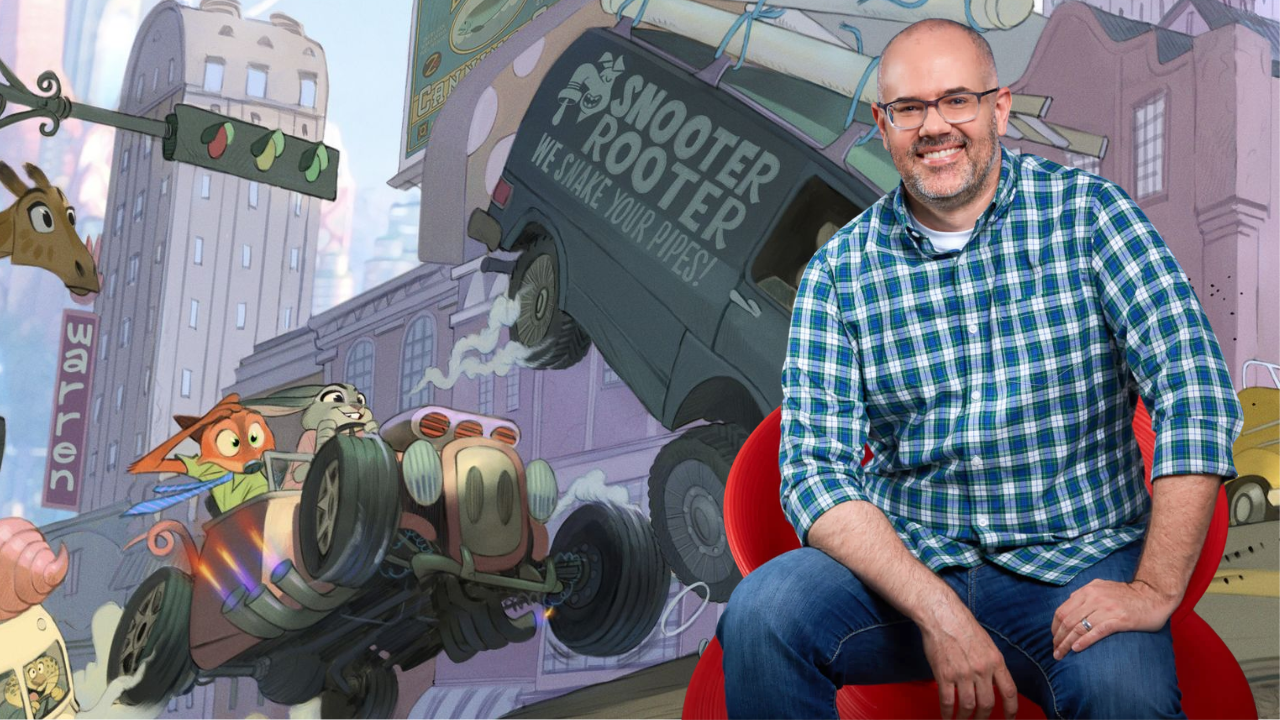
Loftis grew up on a small farm in rural Texas, raising cattle, sheep, chickens, pigs, and a horse, a childhood he'd eventually draw on in ways he never anticipated. Despite a lifelong need to draw, his path into art wasn't straightforward. He had strong grades, and his parents, supportive but unsure how one made a living as an artist, suggested he pursue engineering at a school near a cultural hub. He ended up in New York studying naval architecture and marine engineering, better known as shipbuilding. He graduated just as the U.S. shipping industry collapsed, with most work moving to South Korea, Norway, and China, and he spent time doing offshore drilling-related work in New Orleans.
Cory’s career path changed at Siggraph, where Disney and Pixar were holding a recruiting drive. That moment led him to pack up and move to California to study traditional hand-drawn animation, arriving just as that industry, too, was beginning to wind down. He worked in a small market, doing watercolor and acrylic work for a company that made gift bags for wine bottles, cheese plates, and charcuterie boards. It was art, he said, and he was getting paid for it. Someone noticed his work at school, and he transitioned into video games, spending seven years in that industry before finding his way to Disney Animation, where, naturally, his shipbuilding background meant he was immediately asked to design ships for Frozen.
Loftis made a compelling case for the value of what he called personal history, the specific, lived knowledge that no Google search can replicate. He illustrated the idea with two contrasting desk designs: one belonging to an older adult who had gone back to school, complete with printed instructions taped to the monitor, a covered webcam, reading glasses, and a shelf of physical encyclopedias; the other belonging to a working mechanic, with binders of printed parts catalogs, a mystery component sitting on the surface, and a keyboard permanently stained with grease. Neither set of details, he argued, would occur to someone who hadn't lived those experiences.
The same principle applied across his team. On Strange World, when the production needed to design a large turtle, artist Kevin Nelson arrived at a Zoom meeting with a 50-pound turtle he kept at home. Loftis’ own career detour into board games proved invaluable when the story called for an in-universe trading card game called “Primal Outpost” that helped bond Ethan Clade with his friends and crush.
On Zootopia 2, artist Ryan Lang drew on a Swiss Alps honeymoon to design the abandoned honeymoon lodge with an authenticity of flowers, colors, and architectural details that came from having been there. Associate Production Designer Griselda Sastrawinata-Lemay, whose family is from Quebec, drew on memories of the Winter Carnival's illuminated ice palace to shape the color palette of the frozen Lynxley family estate. The deep purple-blues that brought the sequence to life were a direct personal contribution that Loftis said would never have occurred to him otherwise. His own New Orleans years informed the design of the Marsh Market, the film's swamp-dwelling aquatic district.
Directors Byron Howard and Jared Bush had conceived of a larger animal world history since early development on the first film. Zootopia 2 set out to create a proper timeline, a visible history that the audience could follow without anyone having to say it out loud. That history manifested in several key ways. The Lynxley family estate needed to convey generations of accumulated wealth and power, rendered through portraiture and furnishings that made their anxiety about losing them feel earned. A turn-of-the-century aesthetic was established for the snake and reptile characters, placing them at a specific point in time so that when audiences later encountered the century-old technology inside the weather wall compound, it felt right. A 1990s .com-era aesthetic threaded through Nibbles' website and the gym above Nick's apartment. The honeymoon lodge, deliberately designed to feel abandoned for a hundred years, let the decay itself tell the story without narration.
The art department also created an enormous library of in-world products, printed materials, and ephemera; newspaper clippings spanning a century, handwritten letters, kids' menus for reptile restaurants, fake comic books, all designed to make the animal world feel inhabited and layered. Loftis highlighted Nick's apartment as a particular opportunity: rather than glamorizing the main character, the production leaned into the fact that Nick is a slob, using the space to reveal what he reads, what movies he watches (a lot of Wind Dancer films), and what games he plays. Among the highlights visible in the presentation's slides: a Pete's Pickles label featuring Mickey's nemesis, a fox Robin Hood comic, a Space Fox game (an animal-world riff on Nintendo's Star Fox), and Thorse, a comic parody of Marvel's Thor.
Expanding beyond Zootopia's mammal-centric first film meant developing entirely new architectural languages for reptiles and pinnipeds, two groups that the film establishes have been largely cut off from mainstream Zootopia society. Their fashion is practical and slightly dated; if something breaks, they repair it. Their architecture had to follow a similar logic.
The Marsh Market drew on aquatic animal behavior rather than imposing visual motifs on top of utilitarian buildings: ramps angled into the water so seals and walruses could slide directly up onto rooftops, life preservers and inflatable tubes adding splashes of color, and giant conveyor belts, like those on a water park ride, serving as the primary way for pinnipeds to reach upper floors.
The frozen reptile district presented what Loftis called a triple challenge: it needed to feel reptilian, a century old, and somehow charming rather than grim. The solution was to treat the encasing ice almost like sugar crystals; sparkling, warm, and colorful. Lemay tied the district's buildings together with repeating red column shapes evoking dragon gums and teeth, lending the frozen community a sense of shared identity. One standout detail: artist Mac George designed the interior entry rug of a snake's home in an S-curve shape, reasoning that a snake slithering through its own front door wouldn't travel in a straight line.
The Lynxley family compound went in the opposite tonal direction; cold, combative, and adversarial, with medieval armor and fang-shaped decorative elements, but its cat identity still came through in scratching posts used as columns and small toy balls hanging from alcoves, keeping the space from tipping into pure menace.
One Easter egg Loftis specifically called out: the warehouse scene involving Mr. Big and Fru Fru contained a sewing machine designe to resemble a horse's head, a nod to The Godfather imagery that Mr. Big's character is built around. The Wild Times Club, a predator-only establishment designed for the first film that was ultimately cut, finally found a home in the Marsh Market. Its exterior was used as-is; the interior had never been built in the computer before that scene was cut, so the production started fresh.
Costume design received as much attention as environment design, with each major character's wardrobe engineered to convey something the script never needed to state explicitly. Nick Wilde wears essentially the same outfit as in the first film, deliberately so, because he is a creature of habit, terrified of change. The new version is pink, a color Loftis described as vulnerable, reflecting exactly where Nick is emotionally at the film's start. Pink threads through the film in other subtle ways, tracking Nick's emotional arc. The only new costume detail for Nick is a tie featuring Night Howler flowers, signaling how important his friendship with Judy is.
Judy Hopps, finally seen in casual clothes, is wearing what amounts to her police uniform again with the same blues and tactical fabrics. Her apartment remained largely unchanged from the first film, except for the addition of citations and awards. Her resistance to change runs as deep as Nick's, just expressed differently.
New character Nibbles Maplestick required the most costume development. Designer Ami Thompson eventually landed on a lightweight, mostly waterproof outfit covered in storage pockets, each housing a different type of stick. Some sticks are for starting fires, some (like cedar) for repelling insects, some for carving, and some just for snacking. The specificity of that detail, Loftis said, made the conspiracy-loving, always-prepared side of her character speak before she says a word.
Gary De’Snake needed to feel young, optimistic, and likable despite being a pit viper, so the design process was largely about rounding off sharp edges without losing the species. His belly bag features a superhero print: the Volt Viper, a reptile superhero the art team invented specifically for the film. Loftis shared unused comic pages created for the character, whose premise (a reptile overcoming mammal oppression) explains Gary's persistent optimism throughout the story.
One asset that didn't make the final film: an entirely new set designed for a Mr. Big and Fru Fru sequence, on which Loftis said the team worked through an entire winter. He described the loss of cut material matter-of-factly. "You end up not being sad about the ones that didn't make it," he said, "and you get happy that it ended up being a decent movie at the end of all of the work that you did." Development art for the Hopps family farm, a location the directors have wanted to visit since the first film that keeps getting cut, was also shown, including a long couch built to accommodate an entire bunny family.
“The Art and Visual Development of Zootopia 2" was the kind of presentation that reframes the experience of watching the film. Every background detail, every costume choice, every piece of in-world ephemera is the result of someone bringing something irreplaceable to the table. That density of intention is part of what makes films like Zootopia 2 so rewatchable.