
From Hulk to Hercules: How Project EXO Takes Center Stage on the Disney Destiny


When the gigantic brute Titans take the stage as part of Disney’s Hercules aboard the Disney Destiny, Disney fans will see the next evolution of a technology that has literally grown up in front of our eyes. First introduced at Destination D23, Project EXO later stepped into the parks when Hulk visited Avengers Campus in Anaheim and in Paris. Now, for the first time, we’re seeing the technology used as part of a regularly scheduled theatrical experience.
The 13-foot-tall Titans are packed with lights, fog, and attitude — and yet, inside each towering figure is a dancer who, not long ago, was simply excited to do a Broadway-style show on a brand-new ship.
At a recent media panel, Executive Creative Director Michael Serna was joined by Jeff Conover (Creative Director for the puppet team), Arin Dale (Producer), and Meena Shayesteh (Stage Manager) to pull back the curtain on how this tech — and a lot of good old-fashioned puppetry — turns mythic Titans into showstopping characters at sea.
Conover started by putting the whole thing in context: exoskeletons aren’t new in the real world. They’re usually designed for military or industrial applications, offloading the weight of heavy tools or gear to make them safer to use. Walt Disney Imagineering Research & Development took that idea and pushed it somewhere only Disney would: into character performance.
The result is a full-body exoskeleton system — the "exoframe" — that acts as a skeletal intermediary between performer and puppet. Instead of a suit hanging off someone’s shoulders, the weight is redirected down to the floor, while pneumatic assistance at key joints (like the shoulders and ankles) helps the performer move giant limbs with surprising ease.
For Hercules on the Disney Destiny, that exoframe becomes the foundation for the frost and earth Titans, known on board as the Ice Titan and Rock Titan. Each finished puppet — exoframe plus all the sculpted “Titan” on top — weighs about 120 pounds, with the frame itself clocking in around 40 pounds and the Titan “skin” adding roughly 60–70 pounds of carbon fiber, foam, fabric, and electronics.
And yet, as Conover emphasized, the performer isn’t “carrying” that weight in the traditional sense. They’re moving a mass that’s grounded to the stage, with the exoframe and gas-assisted joints doing the heavy lifting.
To turn the raw exoframe into characters worthy of Mount Olympus, Disney Live Entertainment partnered with Michael Curry Design, longtime masters of large-scale puppetry who also built the Hydras and Nessus for the show. Disney fans will recognize their work from productions like Broadway’s The Lion King and EPCOT’s Tapestry of Nations, among many others.
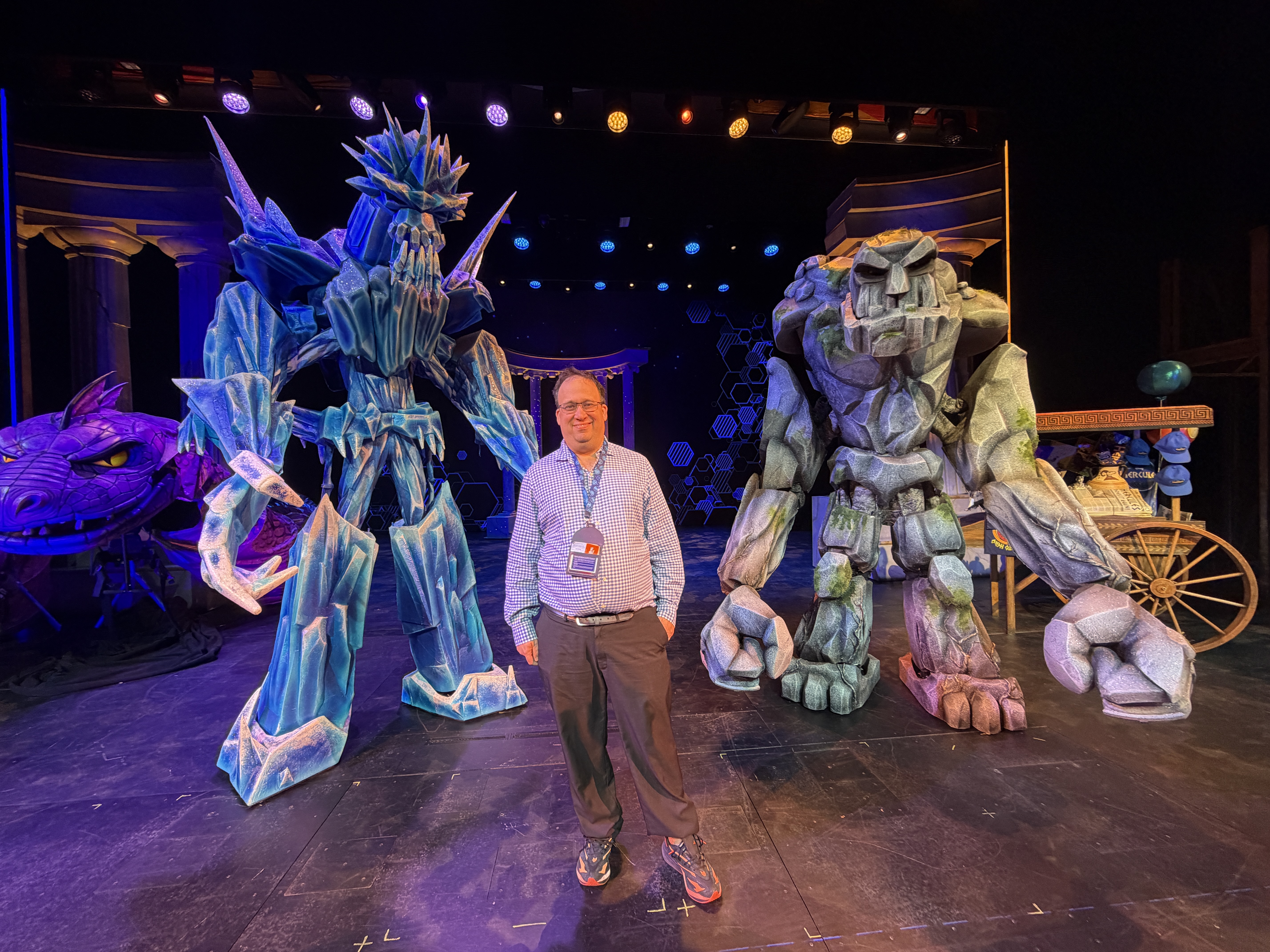
The beauty of the exoframe, according to Conover, is how modular it is. Once the team had a sculpt of what the Ice Titan should look like, they could adjust the armatures — changing shoulder, elbow, and wrist joints — to fit that unique design. From there, it’s a multi-stage build: raw foam, fabric, hand-sculpted pieces, carbon fiber components, and carefully pattern-drafted elements all layered together until a Titan emerges.
Up close, the Rock Titan in particular is a showpiece of detail work. Conover described the figure finishing as “next level,” with rock-like surfaces that read as carved granite and root textures climbing up the legs and arms.
Those details might blur at a distance, but together they create a character that feels like it has stepped straight out of the animated film and onto the Disney Destiny’s stage.
Project EXO also benefited from some high-tech material experimentation. During development, Imagineers played with 3D-printed “muscles” using lattice structures to create flexible, realistic movement. That same design thinking then influenced the shells of characters like the Titans, optimizing the outer forms to be as light as possible while still structurally strong.
One of the most fascinating things about the Titans aboard the Disney Destiny is that they’re not “monster suit” specialists — they’re dancers.
Both Cam (who performs the Ice Titan) and Zion (who performs the Rock Titan) came into the process as dancers first. As Conover put it, they didn’t arrive expecting to spend their contract inside an exoskeleton; in Zion’s case, it was a complete surprise. His reaction: pure excitement at the chance to learn an entirely new skill while still getting to dance his heart out.
These performers aren’t just walking in a heavy suit — they’re executing fight choreography and full-bodied movement while operating the puppet’s arms, head, and mouth. Rock Titan’s performer can execute wide ranges of motion, use expressive jaw movement, and even adjust his positioning based on sea conditions.
These “rough seas contingencies” include grounding Rock Titan’s fists for extra stability, while the Ice Titan can have cane-like icicle pieces added to his arms to serve as subtle supports if needed.
Project EXO has been in active development at Walt Disney Imagineering since 2020, evolving into a versatile platform meant to support a wide variety of characters, not just one type of giant. As Disney continues to prove, it is not the technology itself, but how it is used to deliver a story, where the magic really happens.
We’ve now seen this technology used with a meet-and-greet legacy character in a theme park, and as part of a full-scale performance on a cruise ship. It will be fascinating to see where Disney takes it next, but for now, they truly bring the Titans to life in a way that only Disney can.