
ESPN Radio's Steve Politziner Makes the Case for Radio Advertising at SXSW 2026


Radio reaches 82% of Americans. ESPN Radio alone draws more than 60 million listeners per week. And yet, for years, advertisers have poured their money elsewhere — not because they doubted radio worked, but because they couldn't prove it. That was the central argument at a SXSW 2026 conversation titled "From Podcasts to Radio: Unlocking Scaled Audio with Modern Attribution," where Steve Politziner, President of Good Karma Brands (which operates ESPN Radio), joined a panel of audio industry leaders to make the case that radio's measurement gap is finally closing. Politziner was joined by Matt Drengler, Head of Partnerships at Podscribe; Lindsay Piper Shaw, Director of Offline Marketing Practice at Right Side Up; and David De Rosa, Head of Paid Media at Gusto.
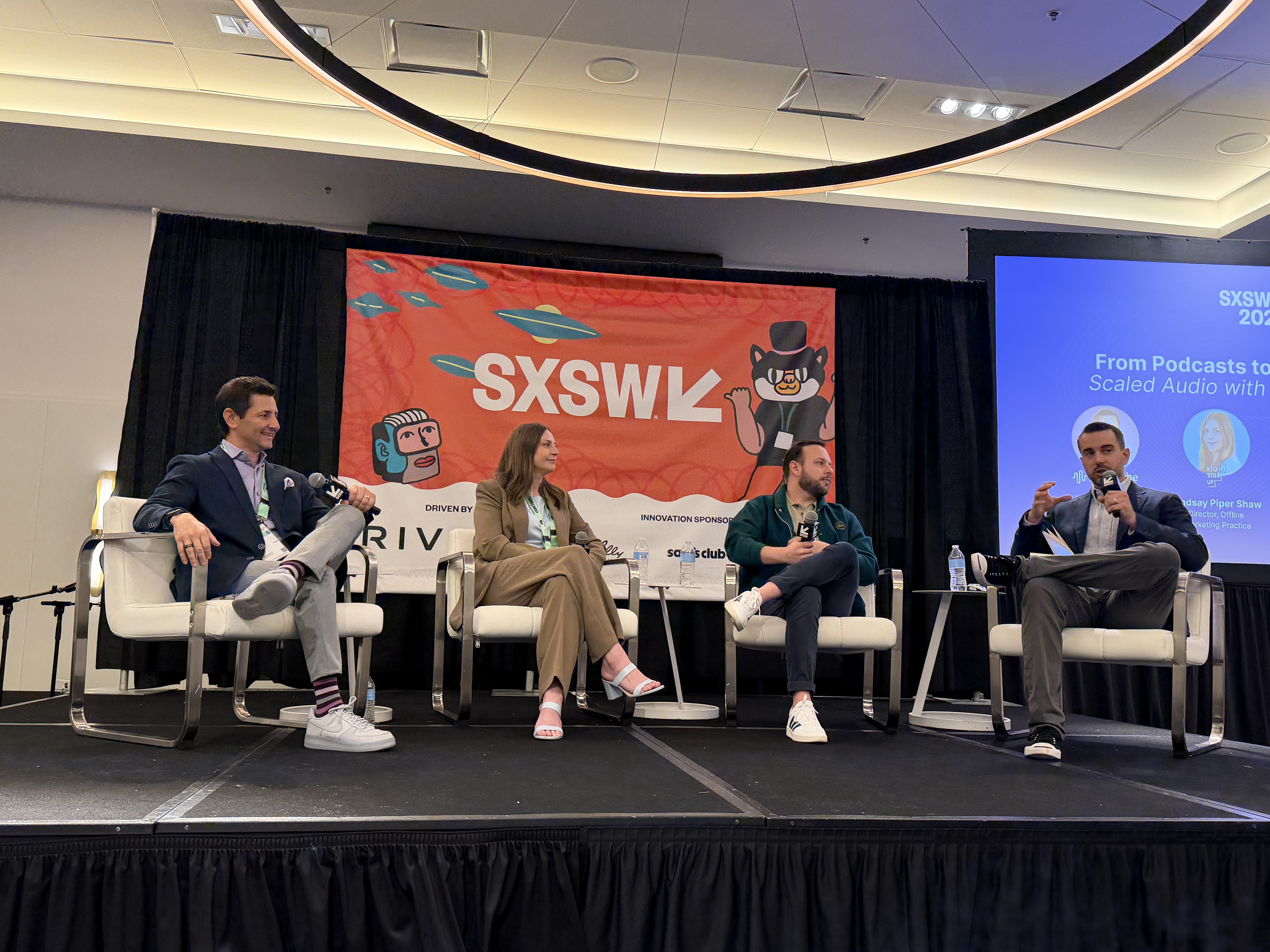
Politziner opened with a frank acknowledgment of the medium's image issue. The word "radio," he noted, has developed a kind of staleness in advertising circles over the years — a sense that it's a holdover rather than a living medium. But the audience numbers have never stopped being impressive. The disconnect, he explained, has always been between reach and proof.
Shaw, speaking from an agency perspective, added that brands tend to start their ad spending in digital channels, where performance data is available in real time. When they eventually consider moving into audio — podcasts, streaming, and traditional radio — the lack of equivalent reporting feels like a step backward. "Radio just feels a little bit old," she said, describing the mindset that agencies routinely push against. "Why am I gonna put my dollars there?"
Drengler pointed to a striking data gap: Americans spend roughly 20 to 22 percent of their media time on audio, but audio captures only about 2 to 5 percent of total ad spending. Traditional radio, he noted, currently has the single largest gap between listener consumption and advertiser investment of any media channel — which, for brands willing to act, represents both an efficiency opportunity and an opening.
Politziner described a recurring scenario that illustrated the challenge ESPN Radio has faced. When approaching brands or agencies about audio partnerships, conversations would often end up focused entirely on podcasts and streaming — the portions of ESPN's offering that come with easy-to-read performance data. The problem: those measurable formats represent only about 9% of ESPN Radio's total audience. The other 91%, tens of millions of listeners engaging with talk programming and live sports play-by-play, were effectively invisible to advertisers operating without the right tools.
"That has always been the crux of the issue," Politziner said. "That audience is there. It's engaged. Particularly in the talk and sports world." The dollars had drifted toward more trackable — and, in his word, "sexier" — channels, even as the traditional radio audience remained substantial and loyal.
The session centered on a new enhanced audio attribution product from Podscribe, built in collaboration with Right Side Up and tested with Gusto as an early advertiser partner. The tool applies a methodology similar to media mix modeling — the traditional approach used to evaluate radio campaigns — but solves the problem that always made that approach so slow: data inputs. By accelerating how campaign performance data is collected and processed, the product delivers weekly or even daily reporting instead of results that arrive months after a campaign ends.
The dashboard it produces looks and functions like what digital marketers are accustomed to: performance broken down by region, time of day, station, and ad creative, with geographic visualizations that let brands quickly identify where their spots are resonating and where they're underperforming.
De Rosa described what that shift meant for Gusto's radio strategy. Previously, evaluating a campaign meant running it nationally for six months to a year, then waiting for a media mix model to return results — sometimes twice a year at best. Creative choices, market decisions, and publisher selections were essentially locked in for the duration. Now, the team can observe performance at the creative level within a week and make adjustments mid-flight, swapping ad spots by station, time of day, or season.
For Politziner, the Gusto partnership served as a proof of concept for what ESPN Radio can now offer. By combining talk programming, live sports play-by-play, and streaming in a single measurable buy, the team was able to move spending around based on what was actually working — something Politziner described as simply not possible under the old model. "It has been driven by that tool," he said. "Would not be possible without it."
During the Q&A, I asked whether ESPN's live sports programming gives radio a particular edge in the current media landscape — specifically, whether the live, commentary-driven nature of sports audio keeps listeners more engaged than passive listening formats. Politziner's answer was direct: live is one of radio's strongest remaining differentiators.
"You want to be around things that you can't skip," he said. ESPN Radio carries the NBA, MLB, NFL, and college football, and Politziner noted that live play-by-play opens up audience segments and brand alignment opportunities that aren't available through talk programming alone. Brands that want to be positioned alongside specific sports or leagues — whether as official partners or not — have a route to those audiences through radio that streaming and podcasts don't replicate in the same way.
He also pointed to on-air talent as a unique asset that the panel kept returning to throughout the session. Shaw compared radio hosts to the original influencers — a framing Politziner embraced. Listeners make an active daily choice about whose voice they tune into, and when talent genuinely connects with a product they're endorsing, that trust carries over in ways a standard :30 spot doesn't replicate. Politziner said ESPN Radio is intentional about its lineup for exactly that reason, cultivating talent that represents a range of perspectives and can align authentically with brand partners.
The panel also addressed how shifting listener behavior has affected the medium over time. During the pandemic, when commuting stopped, radio audiences declined sharply — and, as De Rosa pointed out, the headlines declaring "radio is dead" followed quickly. But with the return to office and the return of traffic, morning and evening drive-time listening has rebounded.
Politziner framed this as an opportunity that now exists without the barrier that previously held it back. "Traffic is back," he said. "People are consuming all forms of audio in that time." With measurement tools now in place, brands no longer have to take on faith that those commute-hour listeners are responding to their ads.
Asked to look ahead, Politziner expressed hope that the distinction between podcast, streaming, and traditional radio would eventually dissolve entirely from an advertiser's perspective — that "audio" would simply be audio, with measurement applied uniformly across all of it. He described the ideal future state as one in which no brand would be told that a significant portion of a publisher's audience is simply unreachable because the data isn't available. "That should be a thing of the past," he said.
Drengler pointed to offline conversions as the next frontier: feeding in-store visit data and point-of-purchase signals into the same models that currently track online behavior, giving retailers, auto dealers, and restaurant chains a fuller picture of what radio is actually driving. Shaw added that cookie deprecation in digital advertising is already pushing more marketers to explore offline channels — and radio, newly measurable, is well positioned to benefit from that shift.
"From Podcasts to Radio: Unlocking Scaled Audio with Modern Attribution" was presented as part of the Brand & Marketing track at SXSW 2026 in Austin, Texas.