
Disney Jr. Opens the Hood on "Cars: Lightning Racers" at Annecy 2026


The Annecy International Animation Film Festival's Work In Progress series gave audiences an early look at Cars: Lightning Racers, the new Disney Television Animation series produced in association with Pixar, debuting in 2027 on Disney Jr. and Disney+. Moderated by Dimitri Granovsky at Pierre Lamy on Thursday, June 25th, the panel brought together executive producers Travis Braun and Frank Montagna, supervising director Nathan Chew, and Pixar producer Mary Alice Drumm, who together traced the four-year journey of bringing one of Pixar's most beloved franchises to a preschool audience, and closed with a never-before-seen clip from the series.
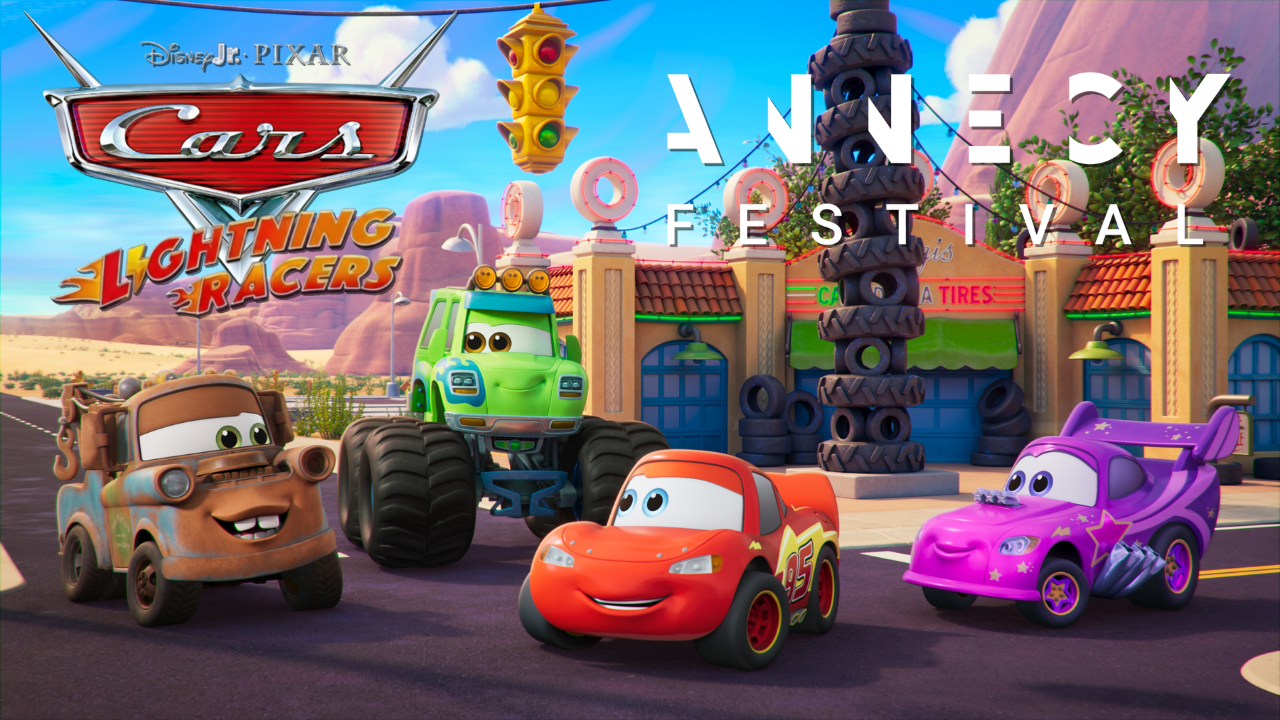
Cars: Lightning Racers follows Lightning McQueen and his best friend Mater on all-new adventures in Radiator Springs alongside two new teammates: thrill-seeking dragster Pipes and mud-loving monster truck Miles. Braun opened by reaching all the way back to his own origins. Racing, he explained, had been the family business since before he was born — his father is an Indy car, NASCAR, and F1 engineer, and his brother is a sports car driver who has won the 24 Hours of Le Mans. "I've been researching this show for 36 years," he joked.
After creating two Disney Jr. series, T.O.T.S. and Pupstruction, Braun kept asking to work on a Cars series, but kept getting turned down while Cars 3 was in production. The breakthrough came when Ayo Davis, President of Disney Kids & Family, and Alyssa Sapire, head of Disney Jr. Original Programming and Strategy, called with an offer he described as being handed the keys to a very fast red race car and asked if he wanted to take it for a spin. "My jaw hit the floor," he said, a reaction that quickly turned to panic over how to adapt the franchise without, in his words, messing it up.
To get it right, Braun, Montagna, and Chew traveled to Pixar in Emeryville to immerse themselves completely in the franchise. They met with Jay Ward, who started as a PA on the first Cars film and has become the brand ambassador who knows every character inside and out, and dug into what Braun called a "treasure trove" of material: abandoned storylines, unbuilt sets, and uncompleted shorts. As Braun put it, what audiences see in the films is the tip of the iceberg, with an entire pyramid of research underneath.
Drumm, who oversaw four of the Cars shorts, emphasized how seriously Pixar treats these characters and praised the team's deep dive into the world's humor and warmth. Disney Jr.'s own testing, the producers revealed, showed that surprisingly little needed to change. Cars is already a runaway hit with preschoolers, from Cars Land at Disney California Adventure to Lightning McQueen backpacks, which are an evergreen accessory for kids.
What testing did surface was a hunger for the everyday: kids wanted to know what Lightning McQueen is like off the track; where he sleeps, what he eats, who his friends are, what movies he watches. That guidance shaped the writers' room, which opened about a year and a half ago under story editor Dana Starfield. With hours of runway the films never had, the series can finally explore Lightning's life beyond chasing the Piston Cup, while keeping one foot firmly planted in the familiar world of Radiator Springs.
Montagna led the design team, working concurrently with the writers so that visuals and story could feed one another. The central challenge was redesigning Lightning and Mater, drawing on decades of interpretations from Golden Books and consumer products to find a whimsical, fun look. Designer Justin Rodrigues built a scale showing how far the character could be pushed before he stopped reading as Lightning McQueen, and the team landed on a chunkier, "chubby" aesthetic that felt right for preschool while still reading as cool and fast. A breakthrough came when character designer José Zelaya pushed the design further, prompting the reaction, "That's our Lightning McQueen."
Mater proved equally tricky; push the eyes too big, Montagna noted, and you lose him. The team kept his core model but adjusted the proportions: a slightly bigger hook, a slightly smaller cab. Realizing the characters would frequently need to grab onto things, the team also gave Mater a front winch, a feature they specifically asked Pixar for permission to add. It resembles a goatee and only drops down when needed.
Guiding the facial work was a note from Pixar that the team returned to often: the cars are essentially a face with wheels. The eyes ended up slightly larger; an attempt to shrink them, Montagna said, simply didn't look as good.
With the leads locked, the team turned to two new friends, each filling out a distinct racing discipline. Miles is a monster truck built for off-road racing, a giant with a heart of gold who is fearful, a little timid, and prone to bumping into things as he learns his way around. The team gave him a paint-splatter design as a nod to his love of mudding.
Pipes, a dragster, is the final member of the Lightning Racers, specializing in straight-line drag racing. The team studied real cars, top fuel, and pro dragsters, but early passes kept reading too much like Lightning. Designer John Jagusak, who worked with Braun on Pupstruction, cracked it with a silhouette like a dustbuster. Where Lightning has a lightning bolt, Pipes gets stars: a star paint job, star-shaped exhaust pipes, and a pink-and-purple palette, finished with a wheelie bar and a parachute she may or may not occasionally forget.
Because Disney Jr. audiences respond to repeatable elements, nearly every episode features a "get ready to race" sequence in which the team gets a transformed racing look. Montagna's team unified the racers around three elements: a lightning hubcap wheel, a flame paint job, and a spoiler.
Translating Radiator Springs meant applying what the team called the "Disney Junior paintbrush," simplifying shapes and colors, and "toonifying" the town while preserving its charm. Braun noted the surreal experience of walking into the world they're creating at Disneyland and studying the Imagineers' work firsthand.
The series also introduces new locations, chief among them the Race Shop, the Lightning Racers' headquarters. Inspired by 1940s and '50s gas stations, diners, and parking garages, it's anchored by a giant tire centerpiece and conceived as a warm, large-scale hangout spot for what is, at its core, a workplace comedy. The racetrack, meanwhile, gets carified details like spark-plug columns, with the drag strip placed nearby thanks to a tip from Braun's visiting father, who pointed out that drag strips typically sit just outside the main track.
For Chew, the central directing puzzle was that the cars have no arms or legs yet must gesture and emote like humans. A self-described doodler, he studied the films meticulously, often sketching in analog with whatever pencils and pens were on hand in the bullpen. For the early animation test, board artist Arielle Yett matched his doodles so closely that the two were nearly indistinguishable, and the team recreated iconic Pixar shots with Icon to prove they could be done.
Chew wrote a short visual-language guideline to keep the team true to what Pixar established, leaning on Jay Ward as the franchise's gatekeeper. He assembled a directing team of varied ages and sensibilities, one steeped in anime and manga, another a traditional Disney fan, to keep the creative perspective collective rather than singular. Practical staging rules emerged: cars are staged horizontally and "cheated" toward the camera like actors on a stage, since there's no acting on the sides of their faces, and animators are encouraged to push expression in boards while preserving the truth of materials (the chassis stays solid; the suspension does the squashing and stretching). The board team numbers roughly eight artists and three revisionists, with assistant director Julius Aguimatang, a veteran of the original Cars, on board.
The panel closed with a never-before-seen clip from the series' third episode, presented in stages from animatic to layout to final render. In it, the Lightning Racers set out to see their friend Joey Lugnut, a trash truck, compete in a trash truck championship. When Lightning and Mater hit traffic, the impatient pair take a shortcut, getting stuck in mud, running off the road by a falling cactus, and getting stalled at a rising bridge. A leap across a ravine nearly ends their trip before Mater's winch saves the day.
At its heart, the producers said, the series leans into the franchise's core values of friendship, teamwork, and community, a message Braun called timely. The team was also intentional about representation, introducing female characters, including Ms. Blinker, Doc Dottie, and Lightning's rival, Odessa, supported by a female director and a female lead writer.
Cars: Lightning Racers is a true labor of love for all involved behind the series. A dream project for Braun, the series is in a race to the finish for its 2027 premiere. With Disney Jr. having success with adaptations of Marvel and Lucasfilm properties, a Pixar series seems like a natural fit, and Cars may just be the perfect first collaboration. Stay tuned for more news on Cars: Lightning Racers as the show gets closer to launch.